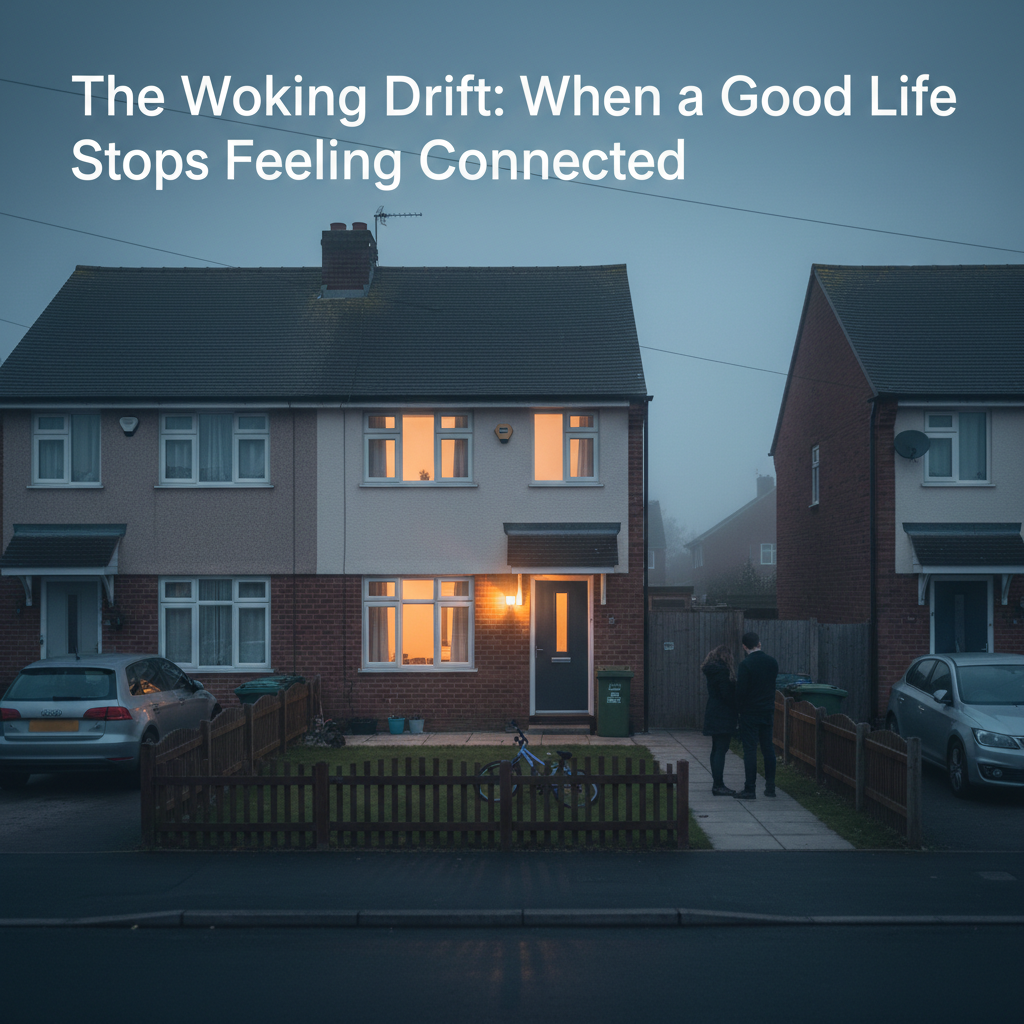
The Quiet Drift: When You've Become Strangers in the Same Home

There probably wasn’t one big fight. No single event you can point to and say, “That’s when it changed.”
Instead, it’s often a quiet realisation that lands on an ordinary Tuesday evening. It’s the feeling of being in the same room but miles apart. It’s the silence that hangs in the air after the logistics of the day – who’s taking the bins out, what’s for dinner, did you remember to book the MOT – have been exhausted.
This is the emotional drift. It’s a slow, subtle disconnection that happens over months, sometimes years. It’s a feeling of being lonely, but next to the person you’re supposed to be closest to in the world. And because there’s no obvious crisis, it can be incredibly confusing and isolating.
The Slow Fading of ‘Us’
From what I’ve seen working with couples from all over Surrey, this drift is made up of a thousand tiny moments. It’s the goodnight kiss that becomes a peck on the cheek, then just a mumbled ‘night’ from across the room. It’s the inside jokes that you stop sharing, because it takes too much effort to explain.
You both become incredibly efficient at managing life. You’re a great team when it comes to the kids, the house, or navigating the busy roads around Guildford. But the partnership, the friendship, the romance… that seems to have been filed away under ‘miscellaneous’.
Conversations become transactional. You talk *at* each other about schedules and tasks, but you stop talking to each other about your hopes, your worries, or how your day actually felt. You might even find you have more meaningful conversations with colleagues or friends than you do with your partner.
Why Does This Happen?
Life, simply, gets in the way. The daily commute, the pressure of work, financial stress, and focusing on the children all demand your energy. It’s easy for the relationship to slip to the bottom of the priority list, always something you’ll get back to ‘when things calm down’.
But things rarely calm down. And over time, you each build your own separate orbits. You have your routines, your ways of coping with stress, and your own internal worlds. The shared space between you starts to shrink. This isn’t a sign of failure; I think it’s a common challenge for modern couples, something we see when a relationship feels lost in Guildford’s busy pace.
The danger is that this pattern becomes normal. The distance feels familiar. The silence between you becomes a comfortable, if slightly sad, habit. You might even wonder if this is just what long-term relationships are supposed to be like.
Recognising the Need for a Course Correction
The turning point often isn't dramatic. It might be seeing an older couple holding hands in Cobham and feeling a pang of sadness. Or realising you have no idea what your partner is currently worried about at work. It's that quiet thought: “I miss them, even though they’re right here.”
This is often when people start that tentative search for 'couples therapy near me' in Surrey. It’s not because the relationship is ending, but because you have a sense that it’s losing its way. You want to do something before the gap becomes too wide to cross.
Taking that step for some early relationship support is a sign of strength. It’s acknowledging that you both value what you have enough to invest in it. It’s about being proactive, not reactive.
How Can Relationship Counselling Help?
Many couples I meet are worried that counselling will be about digging up the past and assigning blame. But when the issue is emotional drift, the focus is very different. It’s not about finding a villain; it’s about understanding a pattern.
Relationship counselling provides a space to have a different kind of conversation. In our sessions, we slow everything down. We pause the back-and-forth of everyday life and create room to actually hear one another again. A therapist can act as a guide, helping you both to notice the small ways you’ve been missing each other.
It’s a chance for reconnecting in relationships, not by forcing it, but by gently untangling the reasons for the disconnection. Sometimes, just having a neutral person in the room is enough to change the dynamic, allowing you to say things that feel too difficult or awkward to say at home on your own.
We help you listen to what’s underneath the surface. The frustration that’s really a plea for help. The silence that’s really a fear of saying the wrong thing. We work on translating these signals so you can start to understand each other’s worlds again.
Is It Possible to Find Your Way Back?
This is the big question, isn't it? For some, the drift has gone on for so long that the paths have diverged completely, and counselling for the end of a marriage might be the kindest way forward. But for so many couples, the connection isn't gone. It's just buried.
The goal is to stop the drift and start consciously, gently, moving towards each other again. It begins with understanding. It continues with small, intentional actions.
It’s not about grand romantic gestures. It’s about putting your phone down when your partner is talking. It’s about asking a question you don’t already know the answer to. It’s about finding five minutes at the end of the day to just sit together, without an agenda.
If you're wondering how to begin this process, finding a couples therapist you both feel comfortable with is the first practical step.
Booking a Session With Us
If you feel that quiet distance in your own relationship and want to find a way back to each other, we can help. We offer professional, confidential relationship counselling for couples across Surrey, both face-to-face in locations like Woking and Cobham, and online via Zoom.
We work on a session-by-session basis, so there’s no long-term commitment. Our fee is £80 per couple for a full hour session. You can book an initial appointment to see how it feels. It’s simply an opportunity to talk, to be heard, and to start building a bridge back to one another.
Written by Sian Jones, Founder of Relationship Counselling Surrey. Sian has extensive experience helping couples improve communication, rebuild emotional connection and strengthen their relationships.